In this issue
Hannah Lutgen
Alberto Ricordi
#74: Native Plants & Conference News (September/October 2023) 
Connecting with the Community through Native Plants

September 1, 2023
Intentional introduction by humans accounts for the presence of over 90% of invasive plant species in Hawai’i. With almost no laws restricting the import of new plants, over 99% of plant species in the world remain legal to import, sell, and grow in Hawai’i. For nearly a decade, the Big Island Invasive Species Committee (BIISC) has been building the Plant Pono program, designed to slow the flow of invasive plants and increase demand for locally grown, non-invasive plant species in the horticultural trade. To earn an endorsement, nurseries are invited to take voluntary action by refusing to sell invasive plants, utilizing best management practices to control pests, and promoting responsible growth by the public. At the same time, consumers are offered tools and education about planting “pono” - choosing non-invasive plants for landscaping and backyard gardening. This program has grown exponentially since its inception. More than two dozen Hawai’i island nurseries are now endorsed, the PlantPono.org website welcomes more than 30,000 monthly views, and several productive education efforts have been launched with partners, including the Landscape Industry Council of Hawaii.
One of the goals of Plant Pono has always been to increase awareness and appreciation of native plants and to promote their use in backyards and landscapes across the island. Increasing the abundance of native plants across our rural landscapes can provide habitat for native insects and birds, reduce the importation of potential pests and diseases that can damage agriculture and watersheds, and increase the knowledge of, visibility, and enjoyment of native plants in our communities. Native plants are living beings that provide a deeper connection to our island home.

Many residents, both kama’aina and malihini, remain unfamiliar with native plants and are often dissuaded from purchasing and growing them due to this lack of experience. For instance, garden enthusiasts frequently request milkweed to provide habitat for imported Monarch butterflies - unaware that attractive, low-maintenance mamaki attracts the native Kamehameha butterfly!
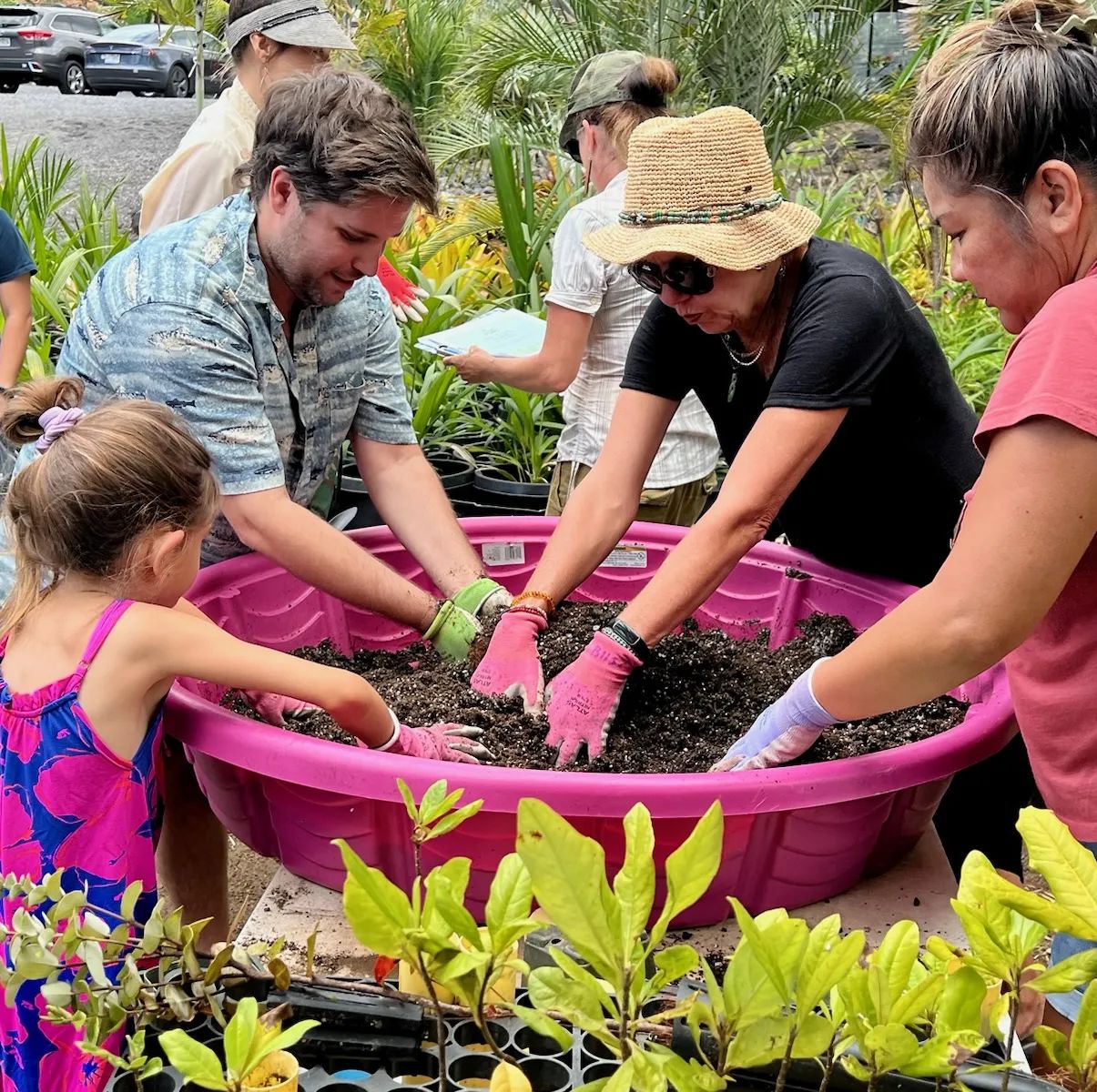
In 2023, thanks to a Kaulunani Urban and Community Forestry Program grant, Plant Pono launched an exciting new program to help increase the supply and demand of native plants in the retail nursery industry: what better way to encourage the production, consumption, and cultivation of native species than a tree giveaway?! During Native Hawaiian Plant Month, BIISC hosted free workshops at Plant Pono-endorsed nurseries around the island. During the workshop, participants learned the proper placement and care of various native plants available and engaged in hands-on work mixing proper planting media and up-potting native trees purchased through the grant.

Figure 2. After learning about their elevation and growing conditions, Molly suggested that Merris take home a Kolea lau lii. We made sure each native keiki had the best chance to thrive.
Throughout the workshop, participants learned about Hawaiian flora and the millions of evolutions that led to the incredible diversity and unique qualities of native Hawaiian plants. Discussions about the use of native plants in Hawaiian culture and medicine, the roles that individual species play in an ecosystem, and the special relationships that plants may have with native Hawaiian insects and birds all took place throughout the session. The hands-on aspect allowed participants to feel a direct connection with the plants even as they learned more about them. Each happy participant left with at least one freshly potted native plant, accompanied by a signed “adoption” certificate that contained future care and planting recommendations, ensuring that recipients continued to feel kuleana for their new flora!
By offering the workshops at Plant Pono-endorsed nurseries throughout the island, community connection with these small, locally-owned businesses was increased. Many participants relayed that they had never visited that nursery before but intended to return - and most left with additional plants in hand! The nursery hosts were thrilled with the upbeat, communal energy of the workshops. Several of them pledged to increase their supply of native plants after witnessing the enthusiastic response of the attendees.
The native plant workshops were so well-received and popular that BIISC plans to make them a permanent part of the Plant Pono program on the Big Island. With a new Hawaii Tourism Authority Aloha Aina grant, we will be able to offer a dozen more workshops over the next year.
Our double goals were successful! One was to influence the nursery supply chain retail market and incentivize the production of native plants. The second was to promote the exemplary nurseries that are Plant Pono Endorsed. It was a win-win for all!
Franny Brewer is the BIISC manager. She can be reached at [email protected].
Molly Murphy is the Plant Pono Specialist She can be reached at [email protected].
Using Native Roots and Microbes for Local Landscapes
By: Barry Solomon & Sonny Gamponia
The traditional Hawaiian system of land management known as ahupua’a was based on the location of streams, but also was a geologic, climatic, and socioeconomic subdivision of land to meet native people’s needs. Each ahupua’a was divided into a lowland cultivated area, and an upland forested area. Ahupua’as were subdivided into smaller sections called ‘ili and kuleana. Sustainable land use and fishing practices were enforced by the konohiki (headmen or administrators of the land divisions) and kahuna (priests). The ahupua’a system worked well until the early 1800s. At that time, the use of fire for clearing forests for agriculture was already widely practiced. Moreover, the precious and fragrant sandalwood forests became deforested by 1825, adversely affecting hydrological regimes that supported fertile valleys, and large-scale sugarcane monocultures were established. The “Great Māhele” land redistribution was proposed by King Kamehameha III in 1848, which was intended to provide secure land titles to native Hawaiians but instead resulted in many people losing land rights. The Alien Land Ownership Act approved in 1850 allowed foreigners to formally hold land titles. While the full history is much more complex and nuanced, suffice it to say that what followed was almost 200 years of significant land use change, land and soil degradation, and the introduction of numerous invasive species of plants and animals.
Tropical lowland shrublands cover around 1,500 km2 on the leeward lowlands of the main Hawaiian Islands. They are one of four traditionally recognized ecosystem regions (ecoregions) in Hawai’i, along with tropical high shrubland, tropical moist forest, and tropical dry forest. An ecoregion is a classification system based on the major macroclimatic conditions where the ecosystems found in the region are usually similar, covering large areas of land and or water. Tropical lowland shrublands contain habitats of tropical grasslands and savannas, as well as shrublands. The Nature Conservancy of Hawai’i has designated a broader Hawaiian High Islands Ecoregion, with tropical grasslands, savannas & shrublands habitats.
In Hawai’i in general and Maui in particular, among these three habitats, the savanna makes the most sense as a target for ecosystem recovery in tropical lowland shrublands. Invasive and wildfire-prone grasses such as guinea, napier, and buffelgrass are widespread, covering around one-fourth of Hawai’i’s lands. However, because Hawai’i lacks large animal populations to eat them, and these areas lack sufficient rainfall to support extensive tree cover for shrublands, long drought cycles followed by pronounced rainfall allowed the invasive grasses to dominate the landscape.
Maui has undergone significant land use changes. The leeward coast with its hot semi-arid climate and average annual rainfall of around 10 inches limits the vegetation to grasses and thorny bushes. The closing of four sugar mills and a pineapple cannery in the last 50 years shifted land use from dryland agriculture to built-up areas for hotels, housing development, and infrastructure. Driving from Lahaina to Kihei, one can see how the invasive buffelgrass and kiawe can resemble an African savanna where wildfires have become an annual occurrence. Unfortunately, the predominance of these non-native grasses was a critical factor behind the catastrophic wildfire that destroyed much of Lahaina in August 2023.
These alien species depleted the environment of native pollinators and degraded the soil. The following list of native plants are historically known to survive in a tropical savanna climate. They can be used to create a native plant community on any scale from a small backyard garden to acres of public lands.
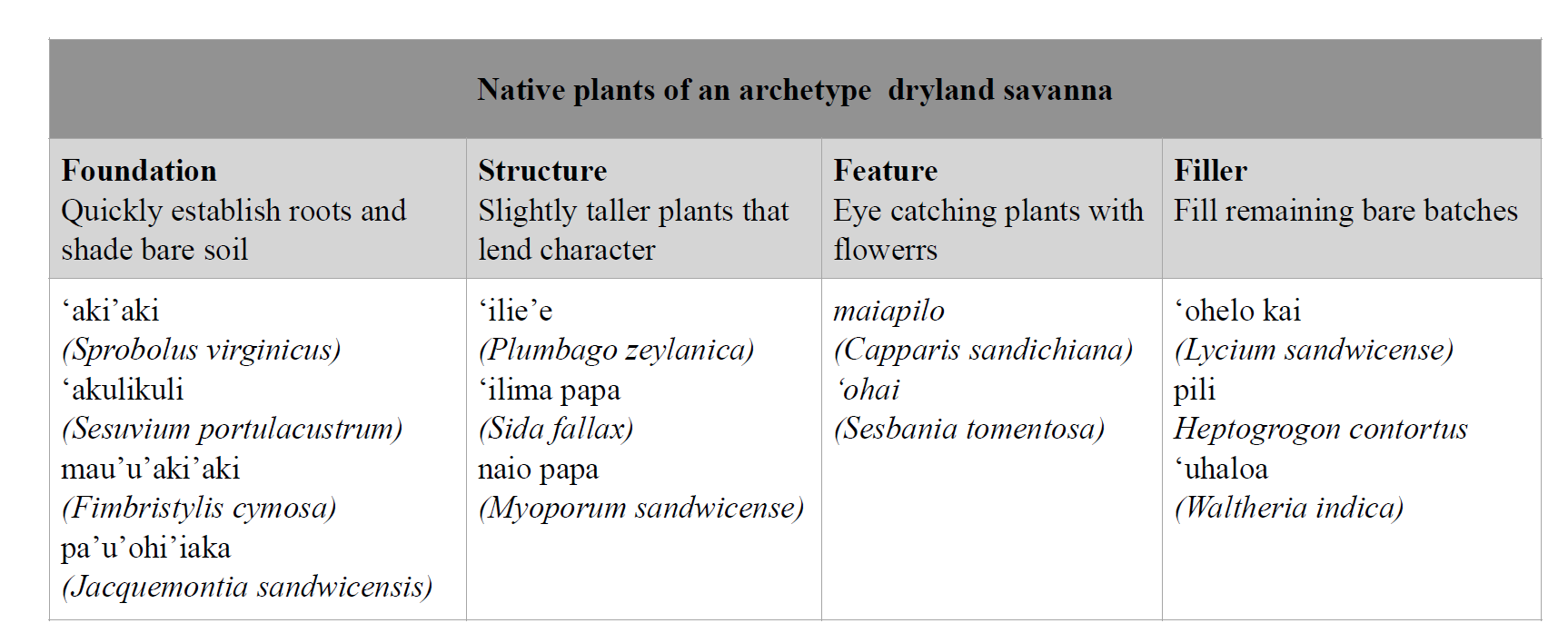
Figure 1. The USGS online document offers the best resource for where native plants once grew on the main Hawaiian Islands. T
Soil biologist Dr. Elaine Ingham, in her YouTube masterclasses on restoring soil, claims you can predict the biology of the soil by observing the vegetation. Bare soil and weeds have scarce bacterial microbes and no fungi, whereas shrublands and forests are dominated by fungi. As the landscape gradually transforms from a grassland to a shrubland, the bacteria population increases, and fungi begin to appear. The bacteria and fungi feeding on living roots become the foundation of a soil food web, attracting protozoa, nematodes, millipedes, centipedes, earthworms, and insect larvae, which helps decompose organic material and hold moisture in the soil.

Figure 2. The ratio of fungi to bacteria increases as the landscape matures.
Research offers compelling evidence of bacteria entering root tips growth at the tips and releasing nutrients within the root. As the roots get longer, fungi feed on the woodier fiber further up the root system. In substantial numbers, these fungal hyphae create networks that benefit the resilience of a diverse plant community.
The book Teaming with Microbes by Jeff Lowenfels and Wayne Lewis offers an easy and inexpensive method of collecting and multiplying microbes by brewing aerated compost tea. This liquid can play an important part in a strategy for habitat restoration and backyard landscaping.
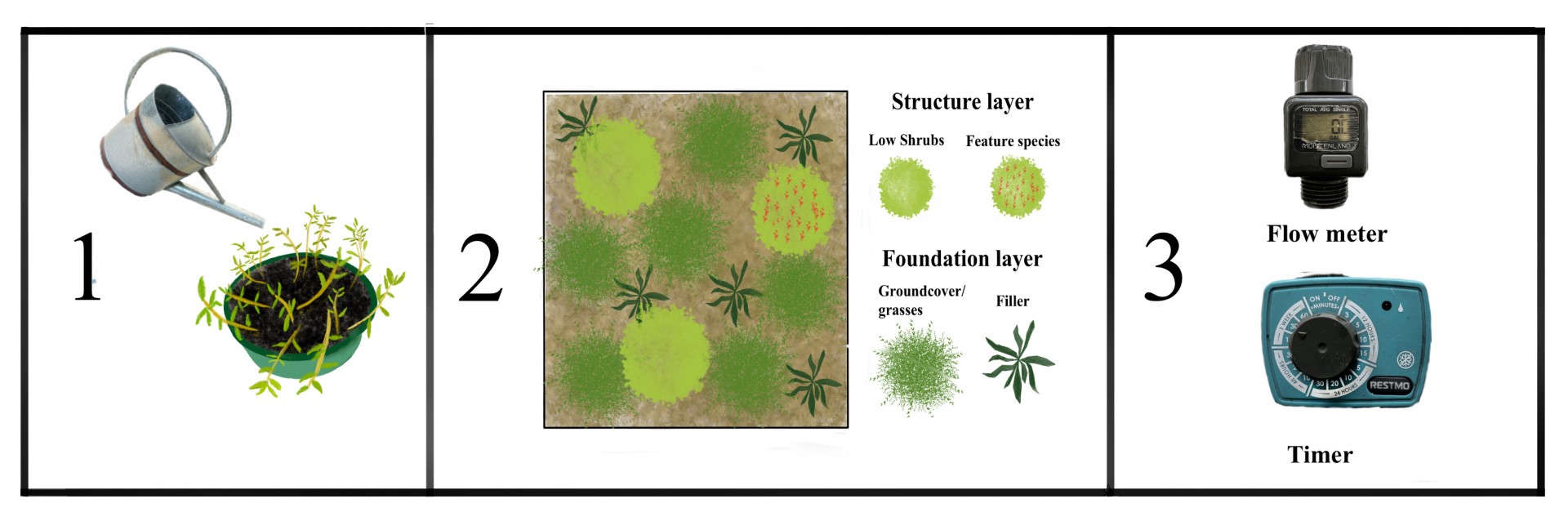
Figure 3. One (1). Aerated compost tea with microbes can be applied to containers of foundational roots of akulikuli, aki’aki and pa’u o hi’iaka before they are transplanted into soil. Two (2). In a 100 square foot area, 60% would be planted with foundational treated with microbes, 40% with structural low shrubs and feature plants. Filler plants can fill in bare spots as the plant community matures. Four inches of mulch will help retain moisture and suppress weeds. Three (
A fragment of a dryland savanna is mature when living roots system and active photosynthesis continue into the dry season, with an occasional rescue during a drought.
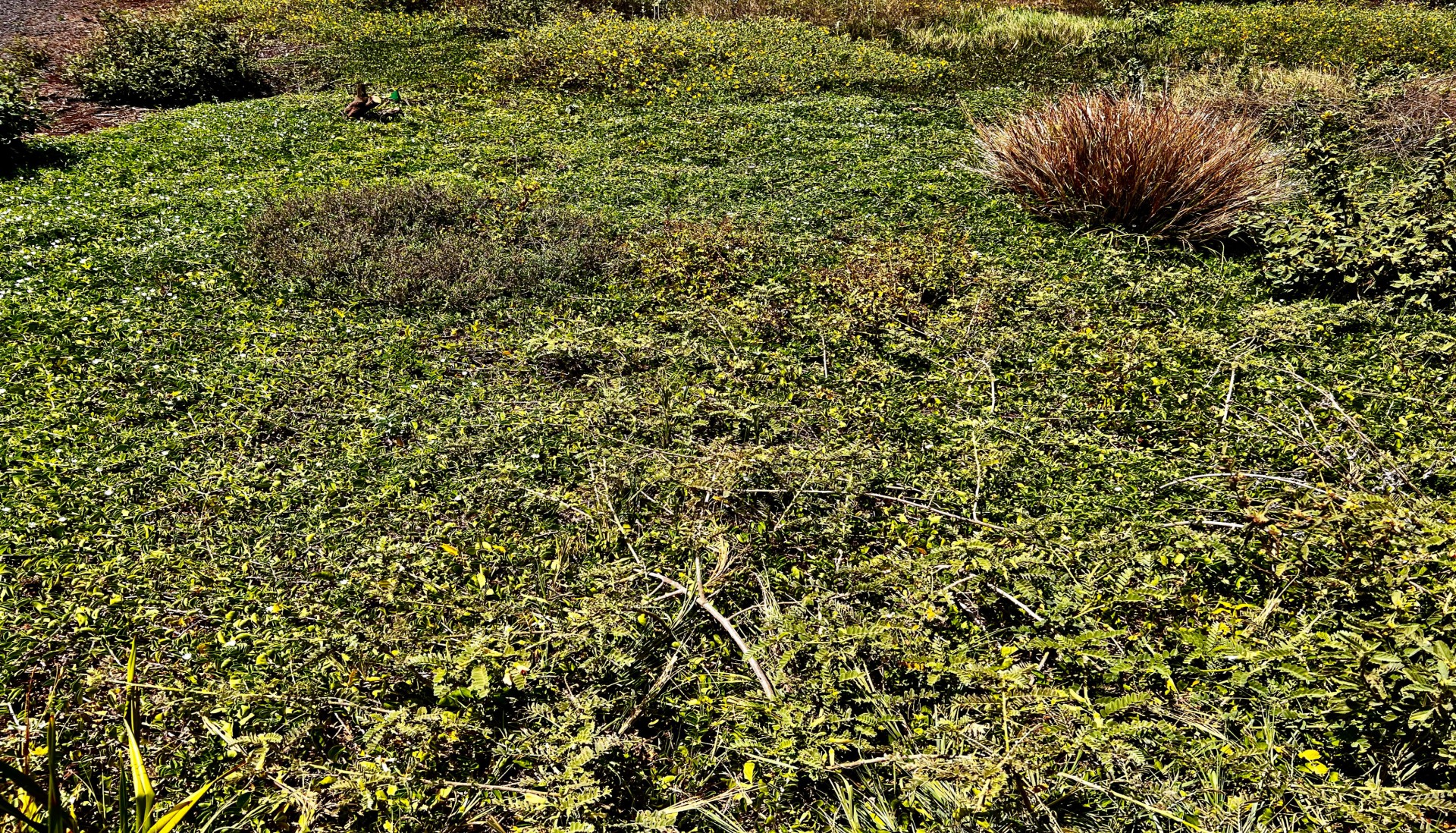
Figure 4. This fragment of a savanna took two growing seasons to fill with living roots and active photosynthesis. Photo by
Each unique native plant community creates a diverse patchwork of ancient habitats that give life back to depleted underground ecosystems. It can attract some of the rarest pollinators in the world such as the Hawaiian yellow-faced bee (Hylaeus spp.), Blackburn’s sphinx moth (Manduca blackburni), the Hawaiian blue butterfly (Udara blackburnii), and the Kamehameha butterfly (Vanessa tameamea). The Hawaiian yellow-faced bee and the Blackburn’s sphinx moth are on the federal endangered species list.
As a backyard garden, it can be considered Hawai’i’s contribution to a Homegrown National Park, a national program for ecological landscaping. The program’s vision is to turn every landscaping project into an act of ecological restoration.
References:
Brewington, L. 2020. Transitions and drivers of land use/land cover change in Hawai’i: a case study on Maui, pp. 89-117 in S.J. Walsh et al., eds. Land Cover and Land Use Change in Islands: Social and Ecological Interactions in the Galapagos Islands. Cham: Springer Nature.
Dance, S. & Selig, K. 2023, August 10. Why Hawaii’s wildfires are so devastating – and ‘predictable. The Washington Post.
Gon, S.M. III & D. Olson. 1999. Focus on Hawaiian biodiversity and ecoregions, pp. 147-150 in Ricketts, T.H., E. Dinerstein, D.M. Olson, C.J. et al., eds. Terrestrial Ecoregions of North America: A Conservation Assessment. Washington, D.C.: Island Press, 485 pp.
Ingham, E. 2022. Science of returning life to the soil.
Lowenfels, J. & Lewis, W. 2010. Teaming with Microbes: The Organic Gardener’s Guide to the Soil Food Web, rev. ed. Portland & London: Timber Press.
Rainier, T. & West, C. 2015. Planting in a Post-Wild World. Portland: Timber Press, pp. 69-93.
Sheldrake, M. 2020. Entangled Life: How Fungi Make Our Worlds, Change Our Minds and Shape Our Futures. New York: Random House.
Siler, J.F. 2012. Lost Kingdom: Hawaii’s Last Queen, the Sugar Kings, and America’s First Imperial Adventure. New York: Grove Press.
Solomon B. & Gamponia, S. 2022. Restoration of fertility to dryland soils with native plants. Hawaii Landscape 68: 5-6.
Solomon B. & Gamponia, S. 2023. Restoring soil fertility to degraded soils with native plants and microbes. Hawaii Landscape, in press.
Tallamy, D. No date. Homegrown National Park. https://homegrownnationalpark.org/
Wessendorf, C. 2022, November 11. Wildfires on the “Hawaii Savanna”. Hawaii Business Magazine, https://www.hawaiibusiness.com/wildfires-hawaii-invasive-plants-environmental-community-action/
White, J. May 20, 2021. Bacteria in Plant Cells: Consequences for Regenerative Crops. https://youtu.be/YHjBqjss1Fg
Barry Solomon is a Professor Emeritus of Geography and Environmental Policy at Michigan Technological University and has volunteered at Kealia Pond National Wildlife Refuge.
Light Amidst Tragedy: Lahaina Tree Restoration
By: Ilana Nimz & Hannah Lutgen
Updated on September 5, 2023
Note: This is a botanical article, and our purpose is not to judge the relative value of the Banyan in Lahaina compared to other damages and losses. Our purpose is to report on the efforts to save trees after a devastating fire, and we leave the judgment of its relative value to those with more historical and political expertise.
There are no words to express the immense devastation that recently occurred in Maui. In August 2023, catastrophic wildfires fueled by hurricane-force winds and a high-pressure system ripped through Olinda, Kula, Pulehu, and Lahaina. These wildfires and strong winds destroyed homes, gardens, crops, businesses, infrastructure, communities, and historical sites: impacting thousands of individuals if not the entire island. Thousands of people have lost their homes and everything they own. The ultimate tragedy is the heartbreaking loss of lives in Lahaina. Even the loss of a town is nothing compared to the loss of human life. We are all irrevocably changed.
Despite this horrific disaster, the community is resilient and determined to revive the rich culture & history of Maui, including the iconic and Maui County Exceptional Trees: the Indian Banyan (Ficus benghalensis) and the ‘Ulu (Atrocarpus altilis) trees, and other culturally significant trees that were damaged in Lahaina.
Although both trees were damaged by the fires, a team of arborists and community members are working to recover them. Steve Nimz is the lead arborist for the recovery of Lahaina’s trees, and he has established a team of experts from near and far to consult on the treatment plan. On the ground, local companies and organizations including Prometheus Construction, Goodfellow Bros., Lahaina Restoration Foundation, Island Plant Company, Naholowa’a Earth Works, and Chris Imonti, are volunteering substantial time and resources to preserving the Banyan, ‘ulu, and other trees that may have survived the fire. Time will tell if these trees will recover, but people and organizations worldwide have offered their products and services to help.
Lahaina ‘Ulu Trees
Several trees in the vicinity are on the Maui County Exceptional Tree list and are treasured within the community. Jesse Neizman and Kalapana Kollars of the Lahaina Restoration Foundation shared a wealth of knowledge about Lahaina Town, and its history with trees.
Before the famed Banyan existed, Lahaina was a lush wetland area, and renowned for ‘ulu (breadfruit) trees. An ‘Olelo No‘eau affirms “Lahaina i ka malu ‘ulu o Lele” – Lahaina lies in the shade of the breadfruit trees of Lele (the old name for Lahaina). Kollars describes that vast groves of ‘ulu once grew in the area, and people could walk across town and be constantly shaded by the ‘ulu trees. The trees not only cooled the climate, but also fed the thriving community.
The Exceptional Trees of Maui County listing “M-9, Breadfruit (Ulu) Artocarpus altilis, a tree planted by Rev. Dwight D. Baldwin in the early 1800s” does not thoroughly capture the significance of this tree’s legacy and its importance to the Lahaina Community. Kollars and Neizman suggest this tree may be truly named “Puloa” and is an offspring of the ancient grove of Lele. The tree was planted as part of a lush garden behind the Baldwin Home, which is now the oldest house standing on Maui. The tree’s more recent decades were lived squeezed between the Baldwin Home Museum’s parking lot and Luakini St. in a small planter space. While the tree’s trunk and canopy did not survive the recent fire, ‘ulu are persistent. Quite possibly, the asphalt could have saved the tree’s root structure from fire damage, meaning suckers may still develop from the ancient tree’s roots.
Even though the Banyan gets the media spotlight, a team of arborists and community members are dedicated to reviving other trees across Lahaina, including Puloa’s offspring. On August 23, 2023, Prometheus Construction removed the asphalt around the trunk and Naholowa’a Earth Works & Chris Imonti added compost tea to the soil to provide beneficial microorganisms to the ‘ulu. Goodfellow Bros. have added this ‘ulu to their map of additional trees to provide supplemental water around Lahaina Town. The stage has been set, and now the water and microorganisms will get to work on reviving the root structure.
The kupuna ‘ulu tree still stands with dignity, even though the trunk is charred. The Lahaina Restoration Foundation will facilitate saving the pieces from the trunk and placing them into the hands of trusted woodworkers. These makers can create beautiful art that will honor the legacy of Lahaina’s ‘ulu groves and Puloa. While rebuilding Lahaina will take many years, beginning planting efforts now will improve soil health, air quality, and restore life to a charred landscape. Returning trees and wetlands to Lahaina will contribute to buffering the community against a warming climate. Let’s envision Lahaina beneath the shade of ‘ulu trees once again.
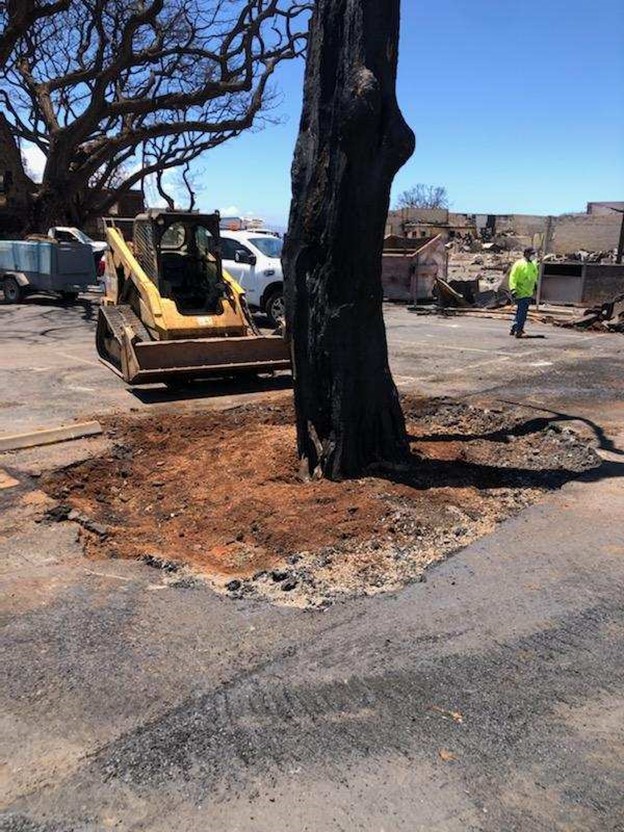
Figure 1. An 'ulu' tree was damaged by the Lahaina fire in August 2023.
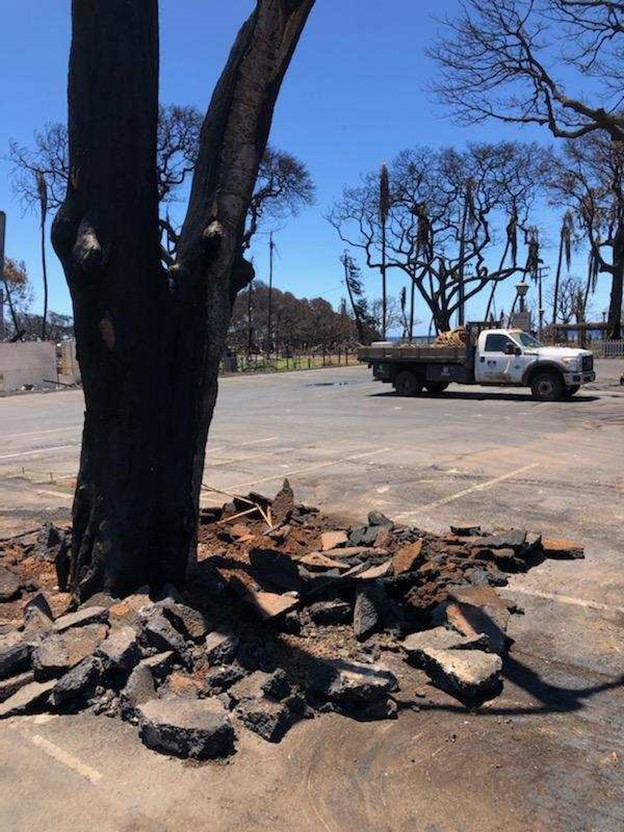
Figure 2.
Lahaina Banyan Tree
The Lahaina Banyan has been growing at the Lahaina Courthouse Square for 150 years and is listed on the National Register of Historic Places. On April 24, 1873, Sheriff William O. Smith, born in Hawaii, descended from an American missionary family, planted the tree to honor the 50th anniversary of the first Protestant mission in Lahaina. Smith was the attorney general representing Maui to the legislature of the Hawaiian Kingdom and participated in the overthrow of the Kingdom in 1893. This connection between the tree and the man who planted it has not been forgotten by the lineal descendants of Lahaina, or by other Native Hawaiians.
Over the many decades, the Banyan has spread over an acre with graceful branches emanating from a single trunk. The tree’s form is a collaboration between nature and the residents of Lahaina who have lovingly cared for and shaped the tree. The tree’s size, aesthetics, and historical value earned it a coveted spot on the Maui County list of Exceptional Trees and a special honor from the National Arborist Association in 1982. While the connection to Smith will always remain, the tree has arguably transformed beyond the intention of the person who planted it and become a gathering space for the community. People throughout Hawaiʻi and beyond our shores have memories of their experience being in the presence of the awe-inspiring Lahaina Banyan. The tree is now a symbol of Lahaina and has fostered worldwide connections to this special location.
Many people wondered what the fate of the iconic Banyan would be following the fire. Local contracting company Prometheus Construction facilitated a rapid tree assessment by Steve Nimz, Consulting Arborist for Tree Solutions Hawaiʻi, three days after the fire. Before work began on the tree assessment and recovery, Kumu Kapono Kamaunu, who grew up in Lahaina, blessed the site and the tree. Nimz inspected the canopy with an aerial lift and found the leaves and fruit were brown, shriveled, and desiccated, and the upper branch tips were dead. Nimz also inspected all of the trunk and aerial roots, and found the two aerial roots and branches on the corner of Front St. and the Pioneer Inn were significantly damaged. The remaining aerial roots were not charred and had live cambium tissue with minimal sap flow. Most of the wooden benches beneath the tree’s canopy survived the fire, suggesting it did not burn as hot under the tree. In a news interview, Nimz shared that “the live tissue in the banyan indicates the tree has the potential to survive, though the tree will require additional and consistent care for many months, especially during the hot and dry summer and early fall”. With the hope of the tree’s survival, a recovery plan was developed in consultation with expert Arborists in Hawaiʻi, California, Oregon, Washington, Arizona, and beyond.
Nimz and a dedicated team are currently implementing a tree care plan that addresses the tree from its roots to its shoots. Goodfellow Bros. are providing daily water trucks to water the tree’s many branches and roots. Water quality is being tested, and soil moisture is monitored daily. Island Plant Company is developing plans for a potential irrigation system.
Peter Bunn is analyzing the soil and comparing it to his historic soil samples from 20 years ago. The Prometheus Construction crew used air spades to reduce the soil compaction beneath the canopy and improve the drainage. Chris Imonti brewed 600 gallons of compost tea and with Naholowa’a Earth Works, they dispersed the tea across the soil to reintroduce beneficial microorganisms and provide nutrients. Mulch and compost will be forthcoming.
Changes in the tree’s trunk, canopy, and roots will be monitored by a team of qualified arborists. ePlant has donated 20 sensors to place throughout the tree to measure changes in the tree’s cambium. As the conditions change, the plan will be adapted to meet the needs of what the tree requires for recovery. Exciting new developments are already happening. Just three weeks after the fire, Allison Wright of Island Plant Company reported new root growth and mycorrhizal activity. On August 31, 2023, Steve Nimz and the team reported new leaves sprouting out of the Banyan trunk (see Figure 6). Rest assured, with the help of the Lahaina Restoration Foundation the tree recovery team is dedicating the same level of care to multiple trees in Lahaina including the exceptional Banyan, Ulu, and other historic and culturally significant trees that have the potential to survive.
As Nimz says, “The tree is going to tell us what it needs. We are going to be listening to the tree.”
To read Steve Nimz’s full report, click here
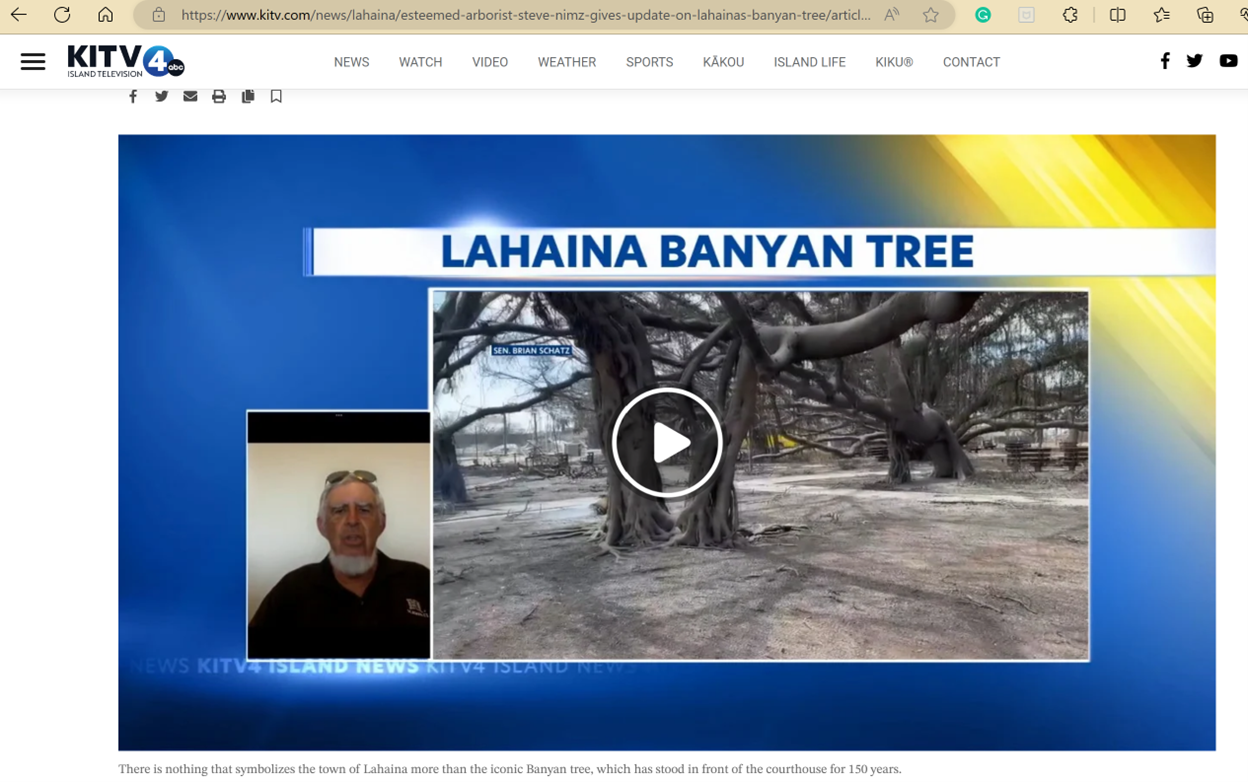
Figure 3. Esteemed arborist Steve Nimz gives an update on Lahaina's Banyan tree. KITV4 Island News.

Figure 4. Steve Nimz aerating the soil.
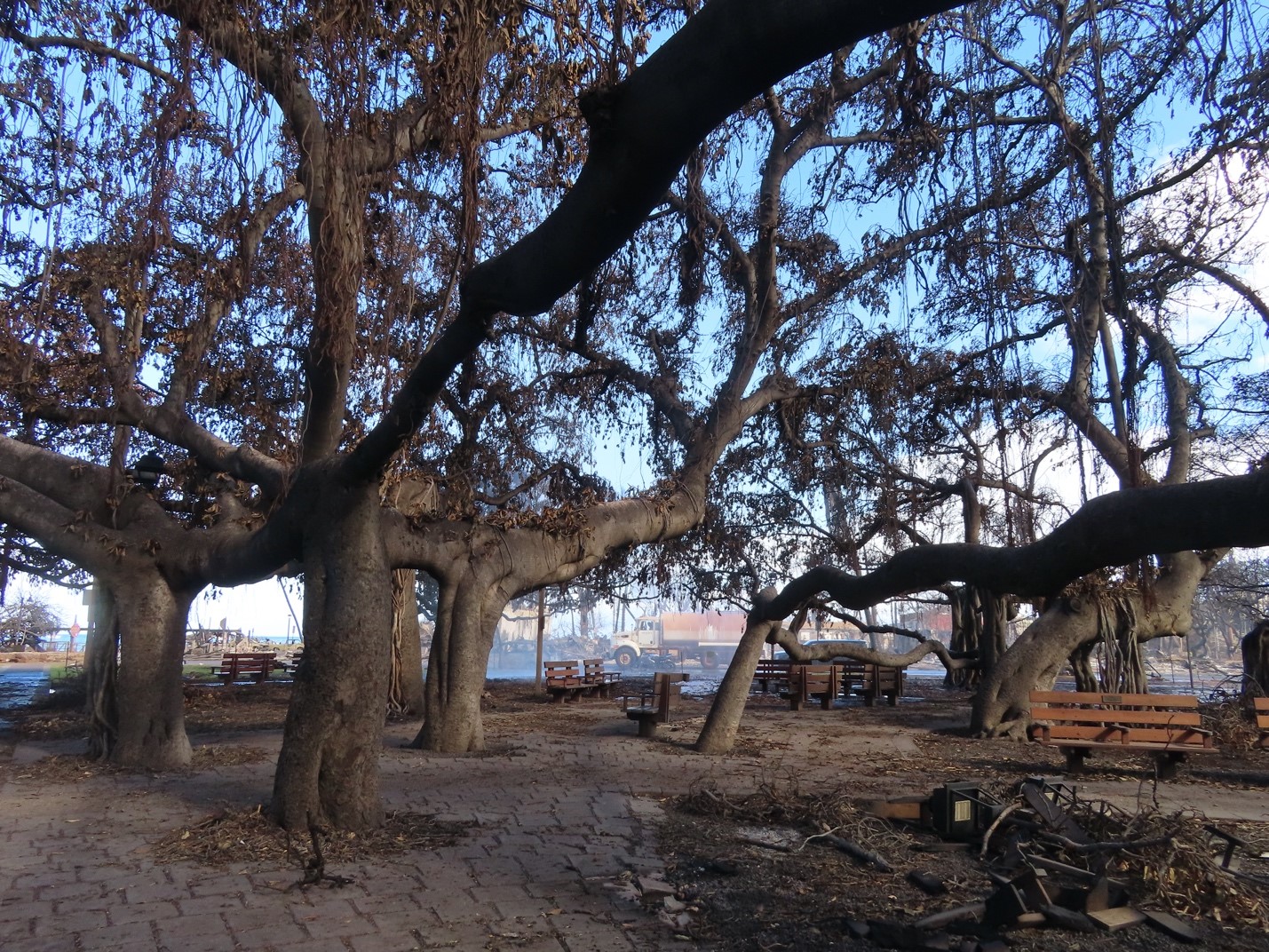
Figure 5. Standing under the burned canopy as Goodfellow Bros. water the tree from a large truck with water cannons.
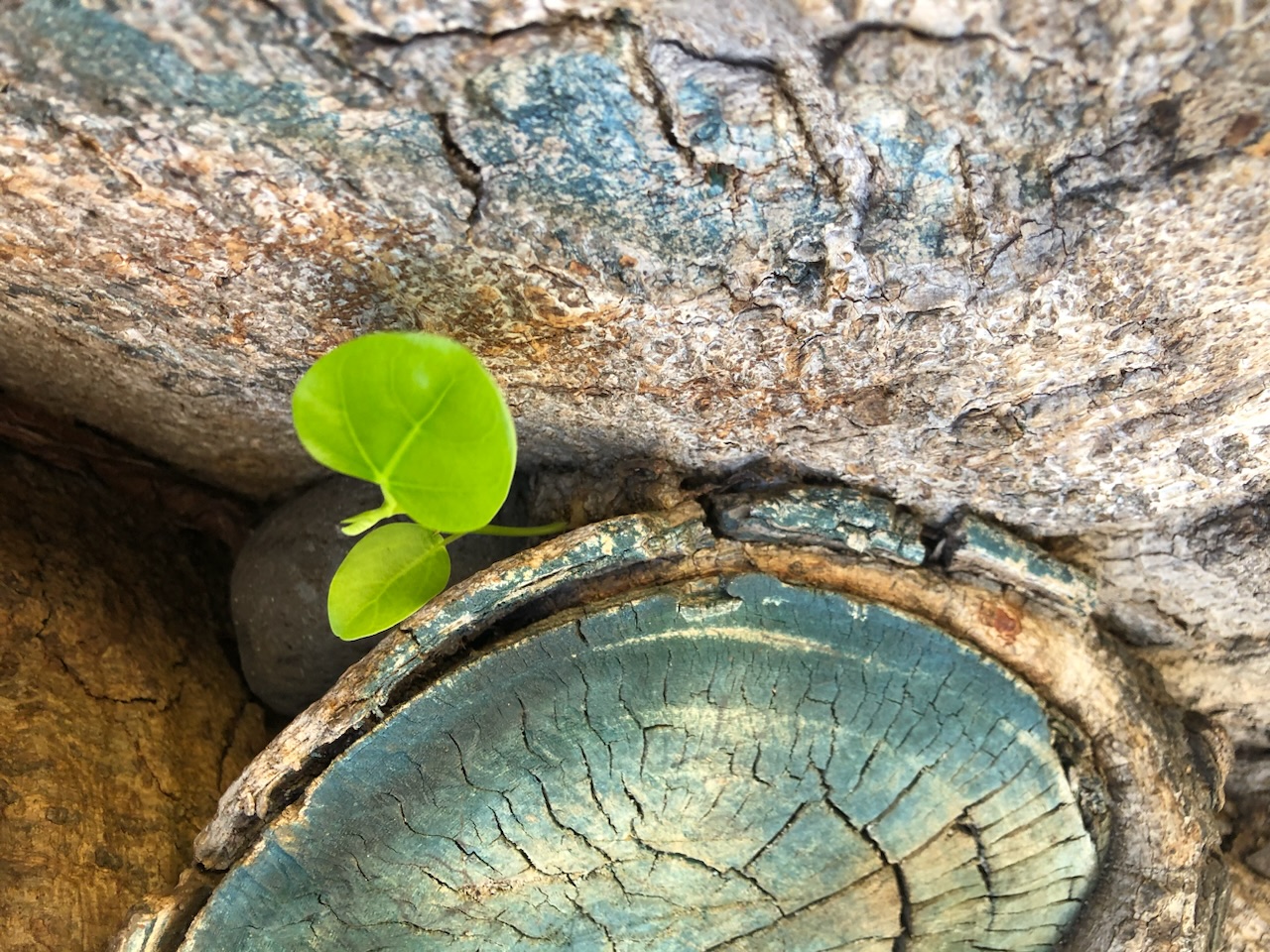
Figure 6. On 8/31/23, Steve Nimz and the team reported new leaves sprouting out of the Banyan trunk. Photo credit: Cliff Tillotson, Prometheus Construction.
The natural disaster that occurred in Maui in August 2023 will forever impact the community: the grieving and loss are inconceivable. Our deepest sympathies and thoughts are with individuals, families, and all people near and far affected by this tragedy. In light of these painful times, the Maui community is strong and devoted to restoring this beautiful island.
References:
Jesse Niezman and Kalapana Kollars (2023, August 18). Lahaina Restoration Foundation. email correspondence to Steve & Illana Nimz.
Lahaina Restoration Foundation. (2023, May 5).
Exceptional Trees Maui County. (n.d.).
Ilana Nimz is a Registered Consulting Arborist and wildlife biologist for her family company Tree Solutions Hawaii.
Hannah Lutgen, Maui County Landscape and Floriculture Extension Faculty Member, University of Hawai‘i at Mānoa, College of Tropical Agriculture and Human Resources.
Hawaiian Alphabet Tree Garden Serves as Oahu Community Resource
By: Tina Lau & Alberto Ricordi
September 1, 2023
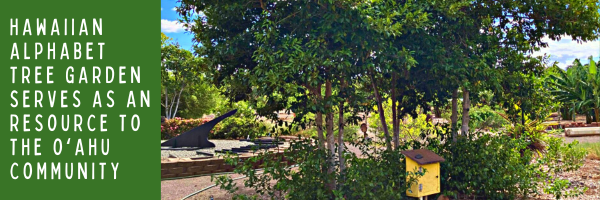
Nestled in the Urban Garden Center (UGC), there is a sanctuary for Hawaiian trees, shrubs, ferns, and ground-cover plants. Common and rare native trees are grouped by the first letter of their Hawaiian name. “A” - for alaheʻe … “I” - for ʻiliahi, … “L” for lama, “N” for nānū and more. Project manager Steve Nagano with consultant Dale Sato worked with collaborators to design and complete the garden in September 2000. The Hawaiian Alphabet Garden currently serves as an educational garden to promote Hawaiian values associated with the traditional use of plants, as a germplasm resource, and as a native landscaping example. Approximately 30 native plants can be found in this exemplary garden plot. Activities in this garden show how UGC is aligning with the University of Hawai‘i (UH) strategic goal to become a Native Hawaiian Place of Learning.
Educational Garden
This year, several school groups participated in activities led by the UH 4-H and Oʻahu Master Gardener programs. Kalihi Kai Elementary students were guided on a walk to see the type of plants that were once common in the lowland and mesic areas of the islands. When Polynesians arrived in the islands, they would have seen plants like those growing in the Hawaiian Alphabet Garden. The students touched the dark green alaheʻe (Canthium odoratum) leaves and some described them as “cool” and “smooth”. As they smelled the flowers they were told why Hawaiians named this plant alaheʻe, or “slippery like the squid” because the gentle fragrance slips along the wind. Some people promote alahe‘e as a Hawaiian Christmas tree because of the characteristic cone-shape of the canopy. When pruned, however, the tree makes an attractive backyard tree that can be complemented by other low-growing ground cover plants like ‘ilima (Sida fallax), or pala‘a ferns (Microlepia strigosa).

Figure 1. Pruned Alahe‘e trees
Traditional plant-use workshops
One of the indigenous plants in the garden is ‘ahu‘awa (Cyperus javanicus), used to make 2 or 3-ply cordage for making a hale, or Hawaiian house. Another cordage plant, hau (Hibiscus tiliaceus) is harvested and used by Master Cordage Maker Ken Ching to demonstrate traditional uses of native plants. Ken practiced his skill while making cordage for the Hawaii Loa voyaging canoe. He eagerly shared his knowledge with the newest class of O‘ahu Master Gardener students. In turn, they assisted Ken, his stepson Kippy, and stepgrandsons Amory and Kekala in a workshop for secondary school teachers organized by the Malama Learning Center to bring Hawai‘i trees into the classroom. The hands-on cordage preparation teaches patience and hand coordination. After skillfully scraping and pounding the freshly stripped hau tree bark, Kippy rolled the fibers on his leg to demonstrate the process of making cordage that could be used for lashing outriggers of canoes, net bags, and shark nooses.

Figure 2. Ken Ching leading a hau cordage-making workshop to train volunteers.
UH Cooperative Extension faculty collaborate with teachers to increase the impact of agricultural programs in schools. Faculty members can provide the techniques and supplies to supplement school curriculum and teachers have the expertise to integrate these techniques into their school curriculum to “enhance the learning experience for their students” according to secondary school teacher Justin Walczyk.
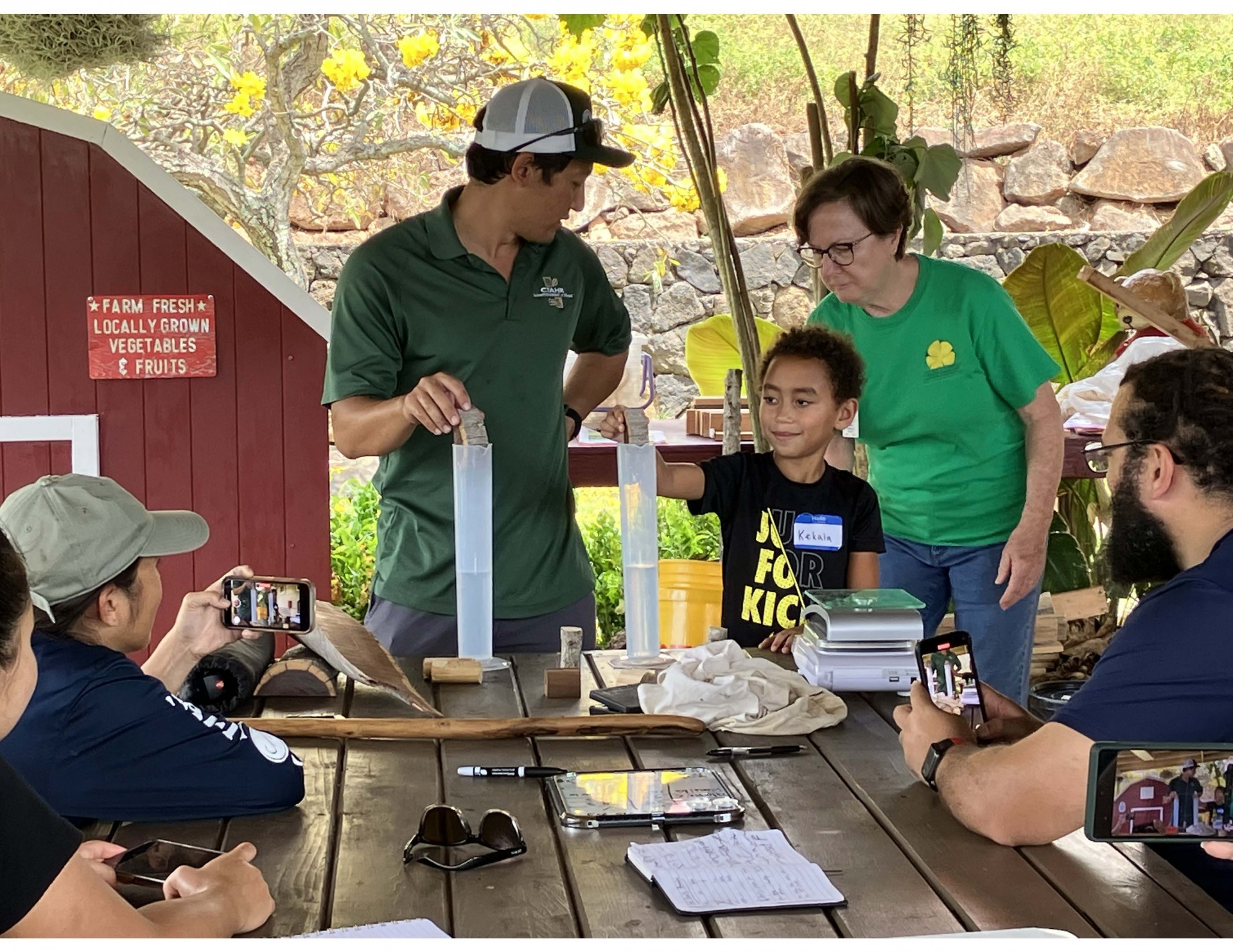
Figure 3. During the teacher workshop, Assistant Extension Agent, Joshua Silva, and Kekala Hanson demonstrated how small pieces of Hawaiian hardwood are used to calculate density.
Germplasm repository
The Urban Garden Center also provides stock plants for schools and community groups to develop native plant projects. Alaheʻe and lonomea (Sapindus oahuensis) seedlings from the Hawaiian ecosystem garden were collected to supplement a “Native Forest Restoration” project at Waiau Elementary School. Their propagation techniques led to great success with over 90% seedling survival. The fourth-grade and fifth-grade classes will be using their school garden for multidisciplinary projects focusing on native plants. The O‘ahu Master Gardener program will work with other schools to provide germplasm in the future.
Xeriscape demonstration garden
The wide selection of plants in the garden can help visitors envision how to design community or homeowner gardens. Visiting the gardens requires making a request through a UH faculty member or coming for a scheduled public event posted on the UGC website event page.
Easy to care for coastal ground cover plant pā‘ūohi‘iaka (Jacquemontia ovalifolia) beautifies the landscape with delicate lavender color flowers throughout the year and can be propagated easily by cuttings. ‘Uki ‘uki (Dianella sandwicensis) grows well in the ground or in containers and produces dark purple fruit with small black seeds that are easy to sprout. Flowering shrubs such as ‘a‘ali‘i (Dodonaea viscosa), kokio ke‘oke‘o (Hibiscus arnottianus), and pohinahina (Vitex rotundifolia) can provide texture and color.
Native plant garden landscaping can be modeled after natural coastal and lowland plant communities. Natural landscapes contain native plants growing side-by-side with dense coverage of the land and promote rainfall capture into the soil to recharge the aquifer. Planting native plants that are adapted to dry climates will require minimal amounts of water once they are established in the ground thereby reducing the need for irrigation and helping conserve water.

Figure 4. Prostrate and erect branching ‘ilima (Sida fallax) provide groundcover alongside an ‘iliahi (Santalum spp.) and kauila (Colubrina oppositifolia) tree, and a dense canopy of alahe‘e trees in the background.
Garden Mana
Other garden areas designed by volunteers incorporate the Hawaiian concept of “mana”, or power. When the UH Tropical Plant and Soil Sciences/Natural Resources and Environmental Management graduate students visited UGC last February, they collected native plant propagules and gleaned tips on specific methods of propagating native plants at the UGC gardens. The students took the propagules back to the Magoon station greenhouses and grew some for sale to the public in April.
Master Gardener Chai Blair-Stahn had chanted a welcome Oli to start the day and by the end of the trip everyone gathered again in the former Hawaiian Medicinal garden that was landscaped with rocks in the shape of a honu, or turtle, that symbolizes the mana of Hawaiian culture. A kukui and breadfruit tree stand deeply rooted upslope of the honu rock formation to transmit the intent of volunteers who designed the garden. The group sat on a circle of rocks symbolizing the head of the honu and shared their manaʻo, or thoughts, about how they benefited from this privileged meeting. Upon closure, this ʻōlelo noʻeau was chanted:
“I ola ‘oukou, i ola mākou nei.”
“May you all (the plants) live, so that we (humans) may also live.”
Safeguarding the Hawaiian plants and gardens contained in the Urban Garden Center gardens for their germplasm that moves the gardens towards creating a Native Hawaiian Place of Learning. It is a special place that contains the positive intent of all prior, current, and future faculty, staff, and volunteers. Educational activities will focus on the biological and cultural significance of these special plants in the garden landscape.
For more information, feel free to contact Tina Lau at [email protected] or Alberto Ricordi at [email protected].
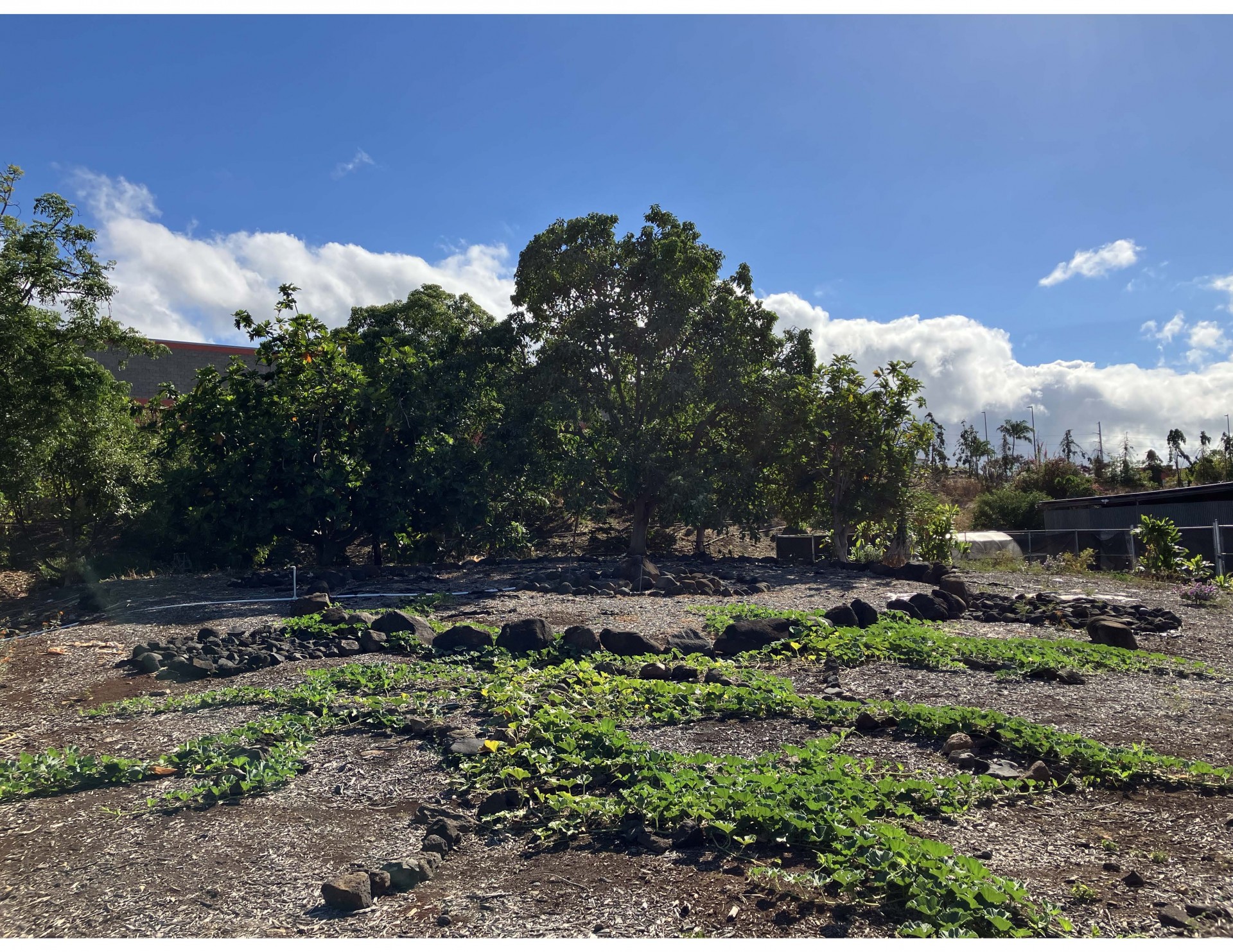
Figure 5. Honu garden.

Figure 6. UH graduate students and Master Gardeners at the Honu garden
REFERENCES
BWS Native Plants for Water Conservation, Accessed 2 July 2023.
Lilleeng-Rosenberger, Kerin E. Native Hawaiian Plants: How to Grow, Cultivate, and Enjoy 25 Popular Plants. Mutual Publishing, 2018.
AUTHORS
Tina Lau, MS. - Jr. Extension Agent, O‘ahu County, Cooperative Extension Service, University of Hawai‘i at Mānoa
Alberto Ricordi, D.Arch. - Landscape and Ornamental Crops Assist. Agent, O‘ahu County, Cooperative Extension Service, University of Hawai‘i at Mānoa
In Tribute
By: Elaine Malina
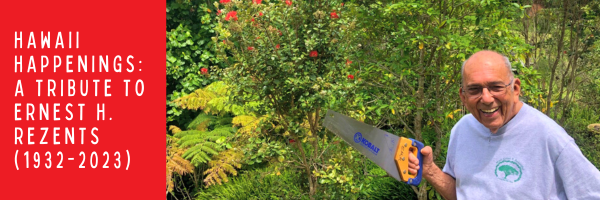
Ernest (Ernie) H. Rezents, who passed away on June 13, 2023, was a tree expert, an ISA Certified Arborist, an American Society of Consulting Arborists (ASCA) Registered Consulting Arborist, a Professor Emeritus Agriculture University of Hawaii Maui College, a recipient of the ISA True Professional of Arboriculture award, a mentor, and a friend. He mentioned recently, as he was reflecting on his age (91) and the loss of his beloved wife, Alene, that he must still be here because he has more to do. Now that he has passed away, it will be up to his many former students and friends, affectionately called “Ernie’s Tree Army,” to carry on his work.
Maui County Arborist & Maui County Arborist Committee
Ernie was the driving force to establish the Maui County arborist position and the Maui County Arborist Committee in 1983. The committee focuses on the legally protected Exceptional Trees of Maui County.
The Arborist Certification Prep Course
Ernie taught the class “All About Trees” from 1995 until 2015, teaching with passion and motivating his students. He challenged and encouraged them because he wanted them to succeed and to be recognized as educated professionals by getting their certifications and following the ANSI Standards for pruning. The majority of Certified Arborists in Maui County are Ernie’s former students.
Writer & Speaker
Ernie wrote more than one hundred articles on horticulture and arboriculture as an unpaid author for the Maui News. Ernie’s philosophy was simple: “Treat trees as you want to be treated; they will reward you with benefits you could not find elsewhere.” Ernie rarely said no to a speaking engagement because he wanted to share his knowledge, from events such as Trees for Honolulu’s Future, Arbor Day at Maui Nui Botanical Gardens, and Maui Green & Beautiful’s Malama the Trees workshops and tree tours.
Volunteering & more
Ernie was on the board of the D. T. Fleming Arboretum (DTFA) at Pu’u Mahoe in upcountry Maui for over 20 years, lending his expertise to the preservation and protection of Hawai‘i’s native plants. The most important challenge was to get the critically endangered endemic alani tree (Melicope knudsenii) to produce viable seeds. Per Cathy Davenport, a DTFA board director, Ernie, along with Anna Palomino, manager of Olinda Rare Plant Propagation Facility, brought the alani tree back to health and vigor, enabling it to produce viable seeds. Forty young alani trees are now growing across Hawai‘i, with additional seeds at the USDA National Seed Storage Lab in Colorado, thanks to the persistence of Ernie and Anna.
The Maui County Planting Plan
The crowning jewel of his career, Ernie assisted in the three editions of the Maui County Planting Plan (MCPP), an excellent reference that is referred to statewide. In Ernie’s own words, “The Maui County Planting Plan is a guide that can help anyone select a tree to fit their environment and needs, and learn how to plant, stake, prune, water and maintain plants. There are no invasive species in this guide and people can use this guide to find helpful information about installing parking lot trees, planting, and pruning trees with illustrated pictures.” The MCPP is intended to be used by design and landscape professionals, government officials, and the public. Ernie’s goal was to establish the MCPP as an official statewide document. Steps are being taken by “Ernie’s Tree Army” to fulfill this goal. The State of Hawaii Planting Plan has a “tree-mendous” sound to it!
"How do we honor Ernie? The answer is trees: planting them and caring for them properly. In doing so, we receive their endless benefits."
Please contact Maui Green & Beautiful at [email protected] if you are interested in assisting with the goal of making the MCPP the State of Hawaii official document.

Figure 1. Ernie Rezents helping out at D.T. Fleming Arboretum volunteer pruning day. Photo by Elaine Malina.
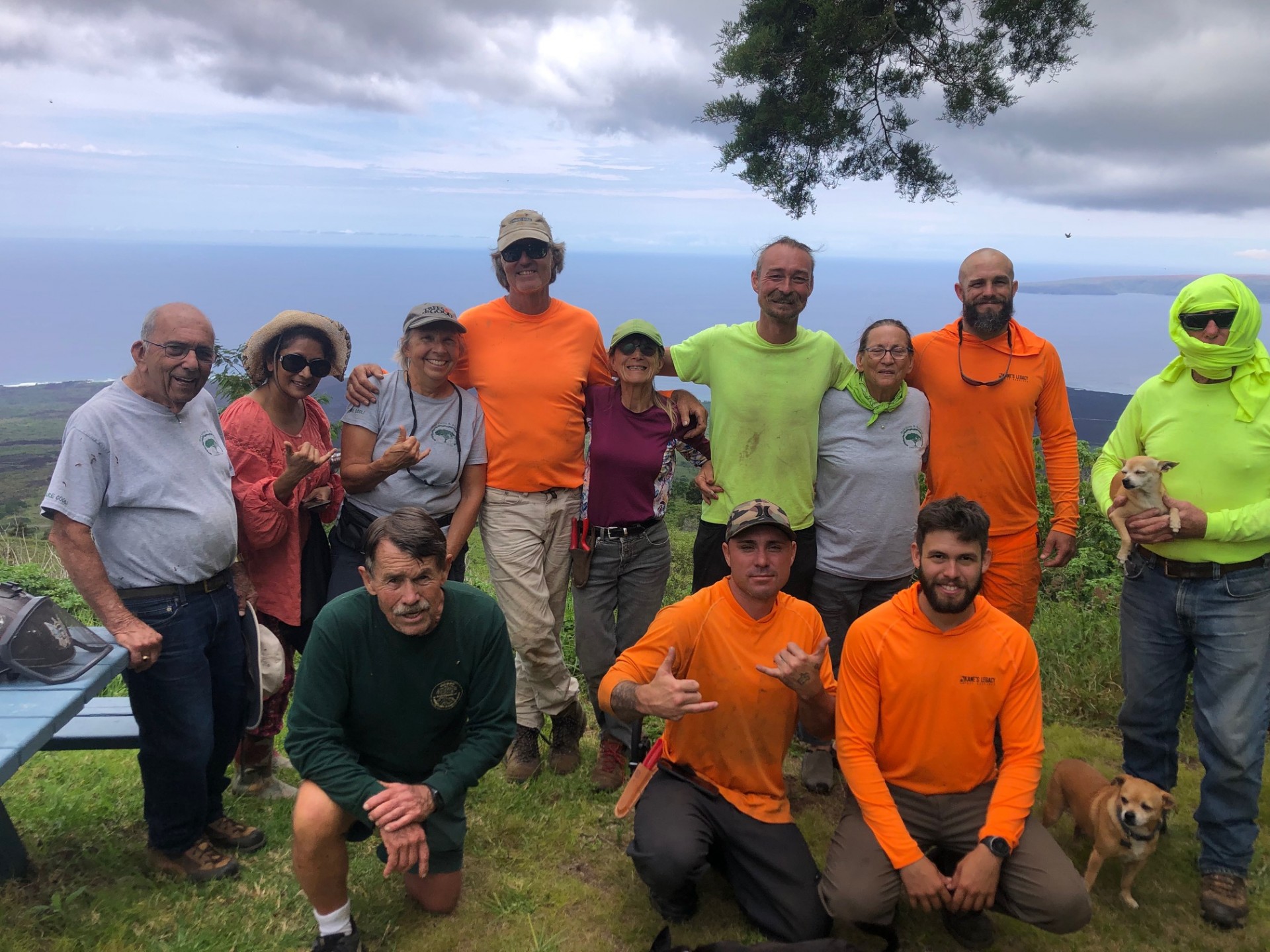
Figure 2. Volunteer Prunning Day to help DT Fleming Arboretum on Maui on May 18,2023. Ernie was out there pruning alongside the other arborists. Arborists and volunteers: Ernie Rezents, Uma Chaluvadi, Elaine Malina, Jeff Gray, Donna Mann, Joseph Peters, Barbara Fernandez, Jake Kane, David Moran, and Sarge McBride. Photo credit: Louise Palmer
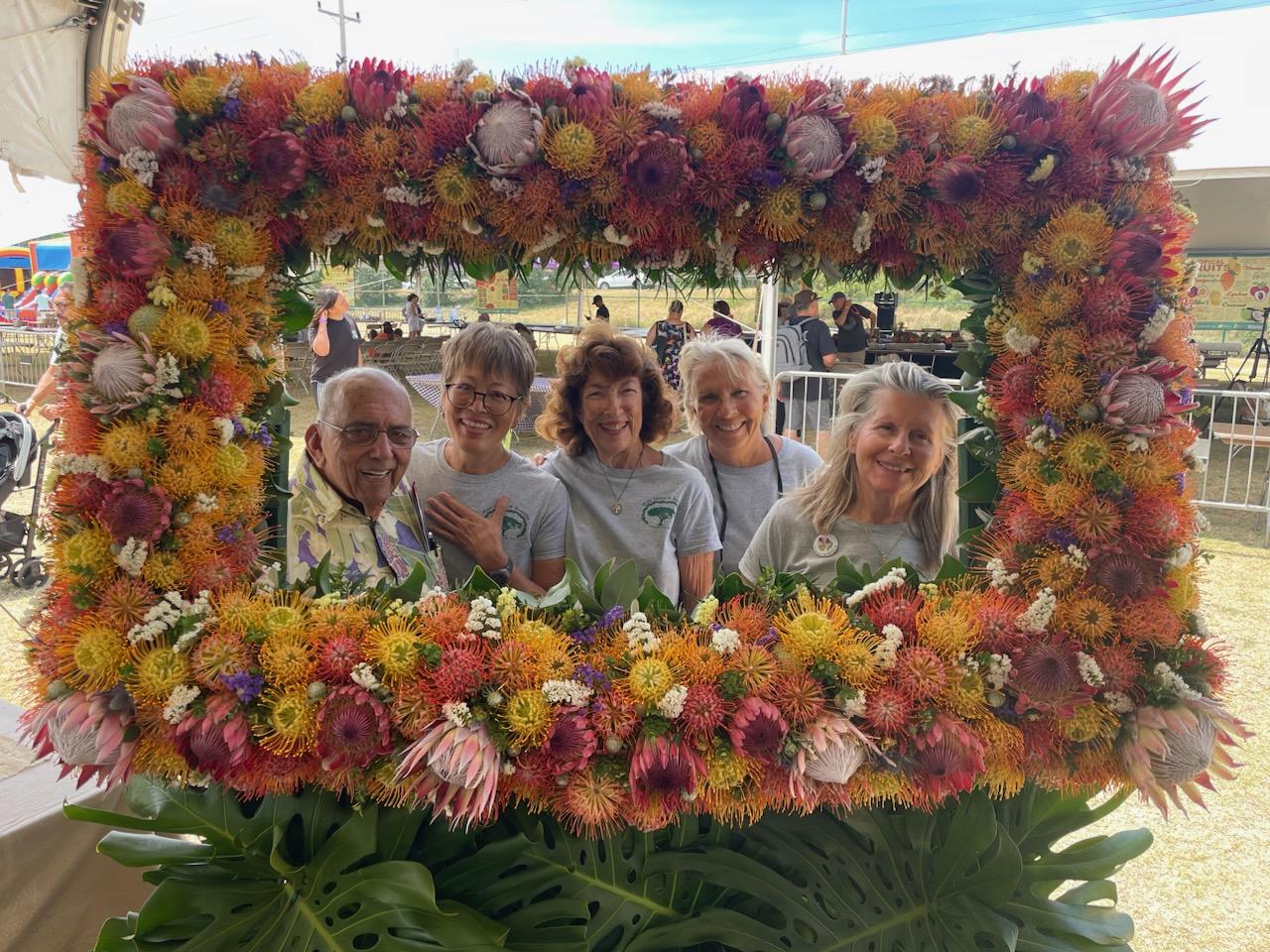
Figure 3. Ernie Rezents at Maui Agfest on June 3, 2023. From left to right: Ernie Rezents, Amy Muramatsu, Arine Bulkley, Elaine Malina, Ranae Ganske-Cerizo.
Elaine Malina, ISA Certified Arborist, past president & current Board member of Maui Green & Beautiful, and Ernie’s friend. This article is dedicated to the family of Ernest H. Rezents as thanks for sharing their dad with the Maui community and beyond.
9 Years of Connecting Communities to Ohia
By: JC Watson
When you drive through a neighborhood, what flowers do you often see? Hibiscus, gardenias and plumeria are fairly common, and we can’t forget the colorful bougainvillea. As for trees, mango, shower trees, and a plethora of palm types are standard fare. But on occasion, if you happen to be in the right neighborhood at the right time you might get a chance to see something special; an ʻōhiʻa lehua tree in full bloom.
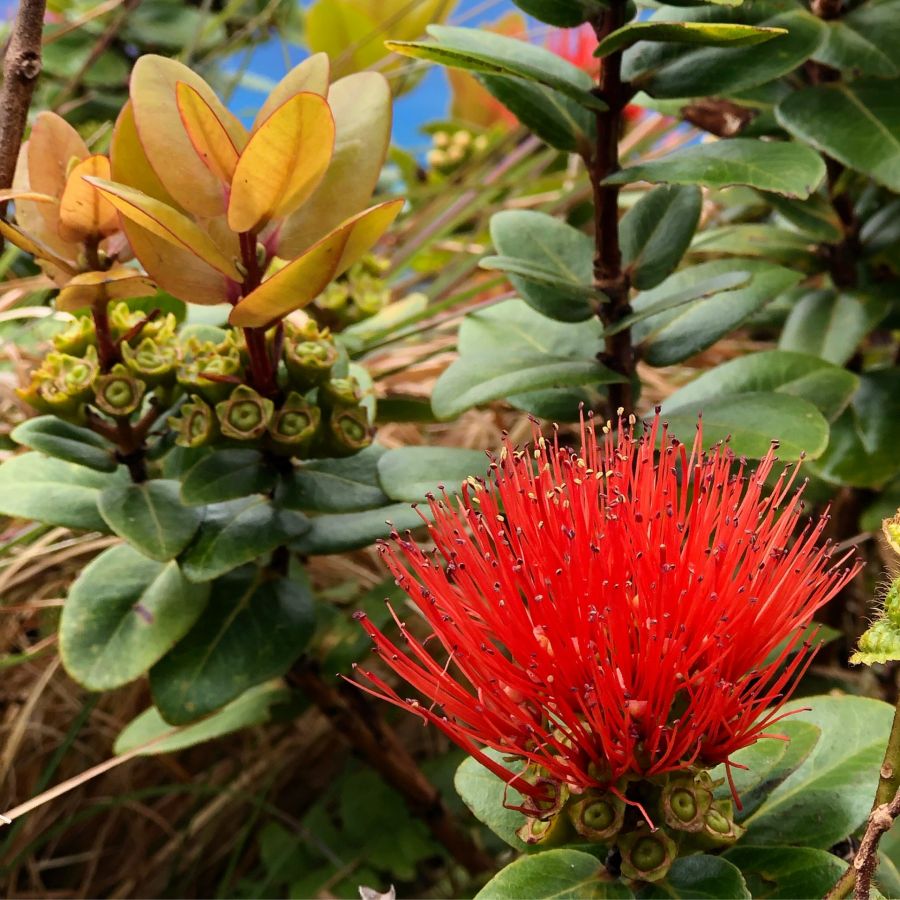
The flowers of ʻŌhiʻa are not only a beautiful addition to any landscape but also provide a valuable source of nourishment for native birds. Photo by JC Watson
ʻŌhiʻa lehua (Metrosideros polymorpha) trees are the backbone of the Hawaiian forest, and once ranged from the mountaintops to the coastal plains. As a pioneer species, it is among the first plants to grow across the cooled lava fields of our islands, and its many forms are suitably adapted to the varying climates and conditions found throughout the state. Their trunks and leaves not only create habitat for countless other species but also effectively capture rain which recharges our aquifers. From a cultural perspective, ‘ōhi’a is very important and has a multitude of traditional uses. For example, the colorful flowers and leaf buds are used in lei making, the bark can be used for laʻau lapaʻau (traditional medicine), and the wood was used to make kiʻi (religious objects) and a variety of tools. There are also innumerable stories and relationships that cannot be so easily described. Tragically, following a long history of detrimental land use practices such as industrialized agriculture and the rise of urban development, this keystone of our native ecosystems is now largely restricted to the upland forests and is an exceedingly rare sight in urban areas.
The ‘Ōhi’a Legacy Initiative (OLI) is a local grass-roots non-profit organization that aims to transform local communities, build cultural connections, increase forest resilience, and develop awareness of native Hawaiian plants by reestablishing ‘ōhi’a trees in urban Hawaiʻi. It was founded in 2014 by three best friends who wanted to make a difference and leave a positive biocultural legacy for future generations. Since its formation, OLI has been taking innovative steps to realize their goals.
With a primary mission of increasing the number of ‘ōhi’a, OLI has worked to develop a decentralized community propagation network which is comprised of organizations, individuals, and local nurseries that share the kuleana of growing and caring for new ʻōhiʻa seedlings until they are large enough to be distributed. Once the trees are about 1-2 feet tall and have filled out a 1-gallon pot they are ready to go to new homes. Though smaller trees are capable of surviving being planted, larger trees have a better survival rate and are much easier to avoid with a mower or weed-whacker. Their next step is to amass the trees by hundreds and coordinate mass-giveaways to provide ‘ōhi’a to the community at no cost. As of the beginning of 2023, OLI has provided over 3,000 ‘ōhi’a trees to communities across O’ahu with hundreds more distributed via partners across the State. Giveaways are promoted via their social media and email list.
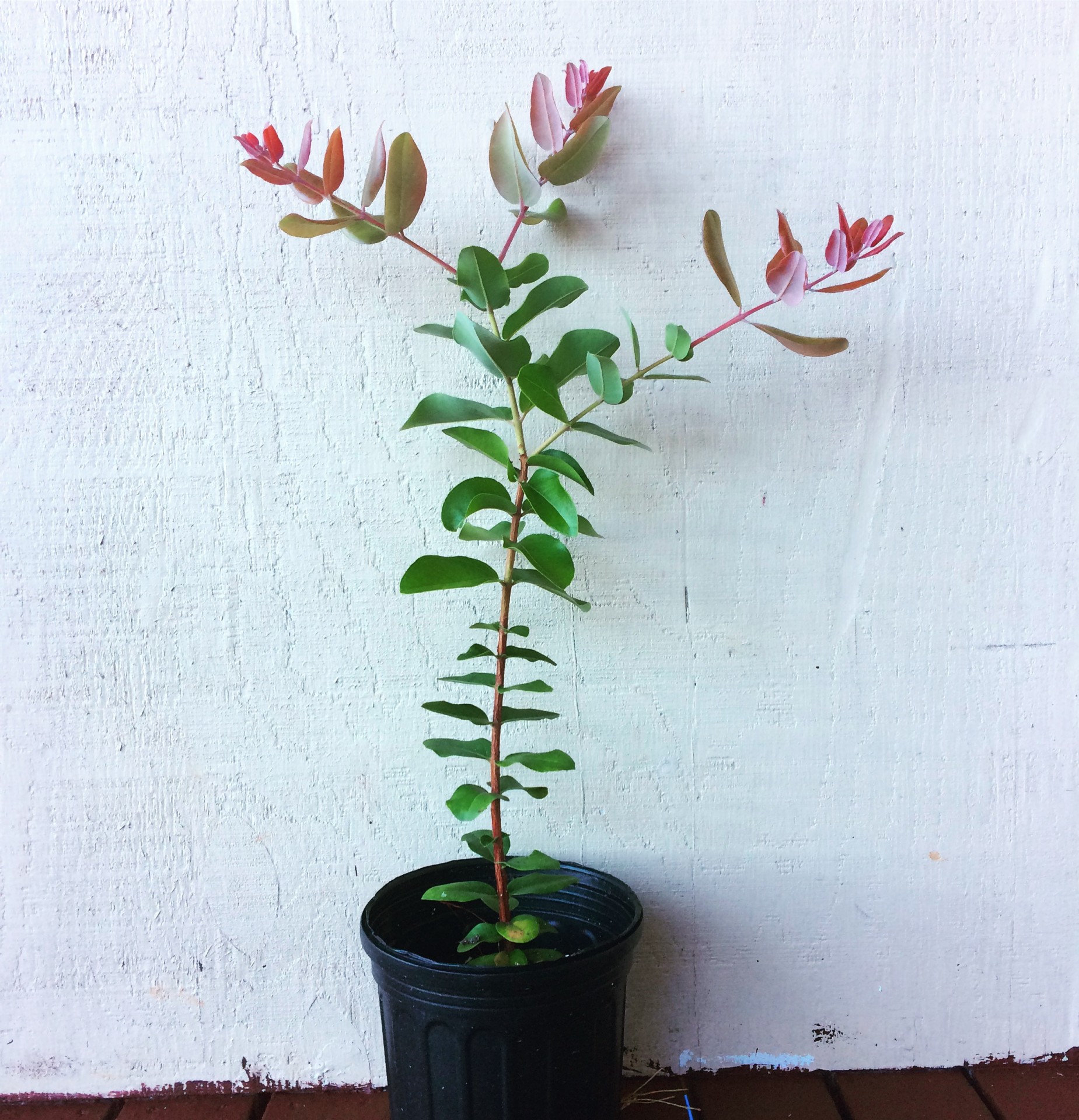
A keiki ‘ōhi’a ready for a new home.
To create a lasting educational component within the organization and continue engagement while trees are growing out, a standardized propagation method was developed which can be used to effectively grow ʻōhiʻa from seed. This technique is intended to be simple, repeatable, and result in high germination rates. Using this technique, OLI has partnered with over 120 organizations, schools, clubs, and businesses to hold ʻōhiʻa workshops. During these events, participants learn about the ecological and cultural significance of ‘ōhiʻa, how to grow it using OLI’s method, and leave with a seeded ʻōhiʻa set and the knowledge on how to care for ʻōhiʻa at their own homes. To date, over 5 million seeds have been sown at their workshops and tabling events across the State.
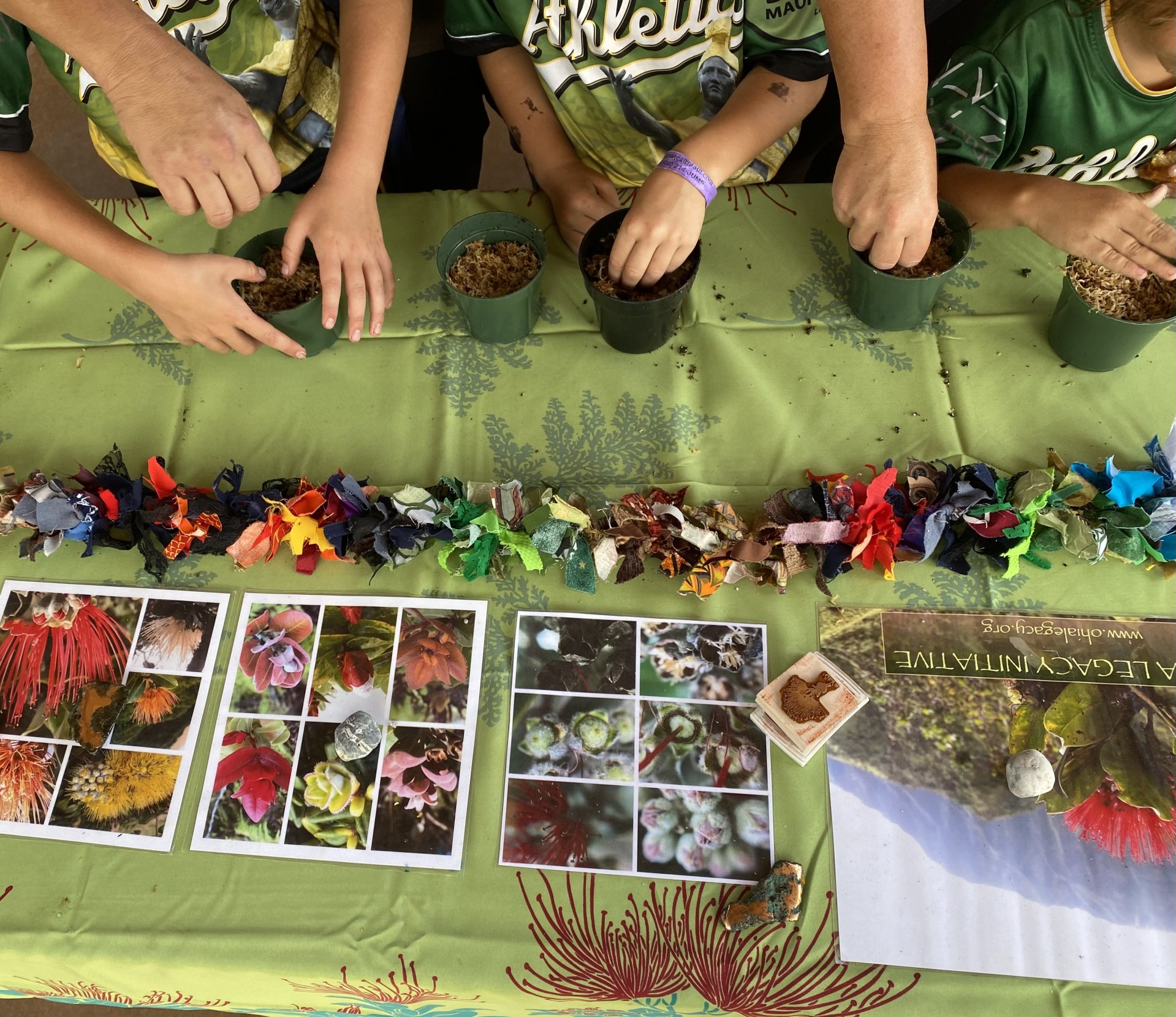
Participants learning to grow ‘ōhi’a
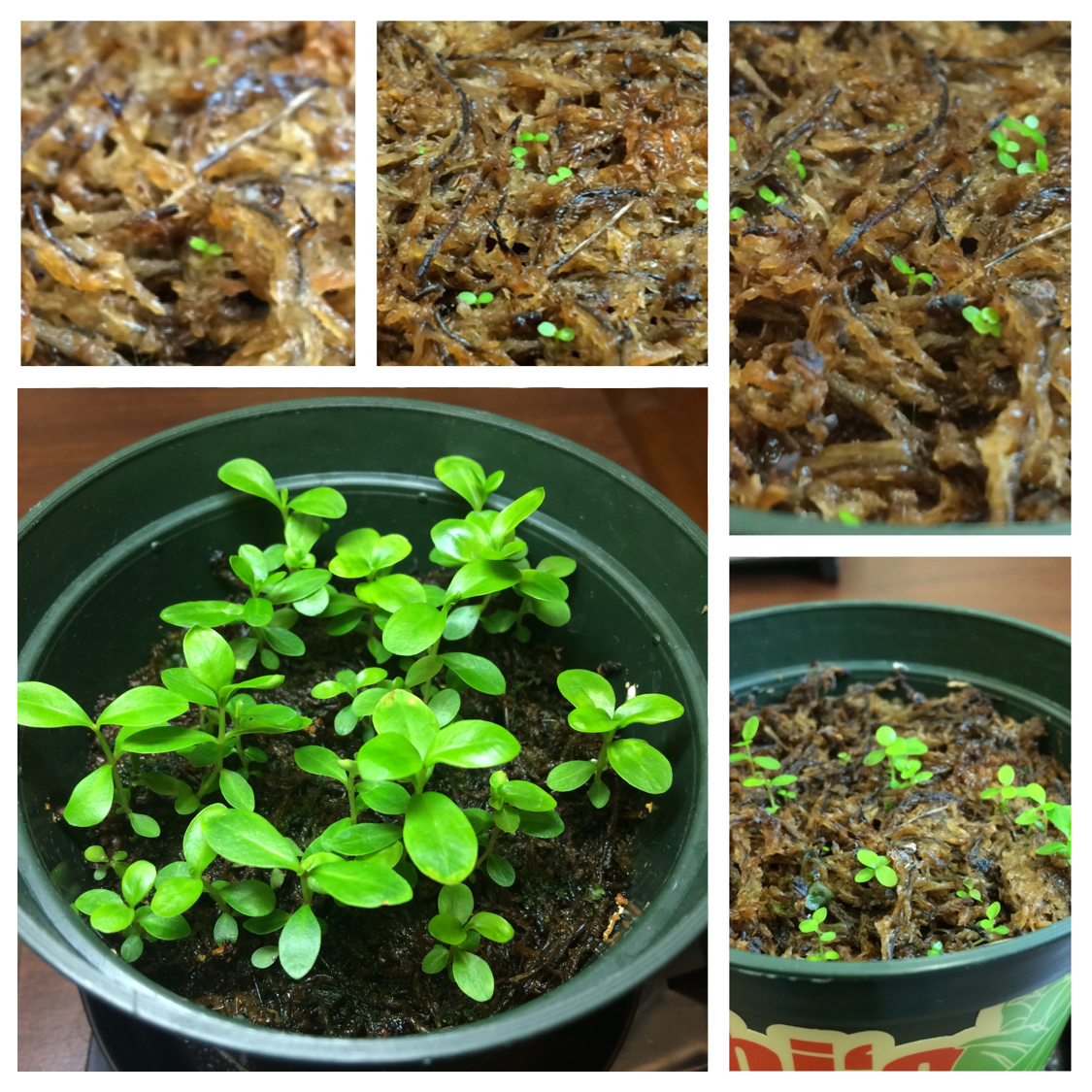
‘ōhi’a propagation
Over the course of their 9-year history, OLI has slowly continued to set down its roots, strengthen people/plant relationships, and have notable impacts in the community. Make sure to stay tuned as they have some big plans for their 10-year organizational anniversary in 2024. For more information, or to learn how to get involved with the ʻŌhiʻa Legacy Initiative, please visit www.ohialegacy.org or check out their social accounts @ohialegacy.
JC Watson is a life-long conservationist and the President of the ʻŌhiʻa Legacy Initiative he lives in Mōiliʻili with his family and plants.
Conference Tour features 3 Significant Properties
By Brad Tanimura
Not only is the LICH conference back this year, so is the post Conference Field Trip! On Friday, September 15th, one day after the Thursday conference, LICH is hosting a tour of some of Honolulu's most interesting landscaping projects. Many of you can recall the former guided tours to Hui Kū Maoli Ola, Hawaiian Sunshine Nursery, Turtle Bay’s roof top landscaping and dozens of other interesting landscape projects. We expect this year's tour to prove to be just as enlightening.
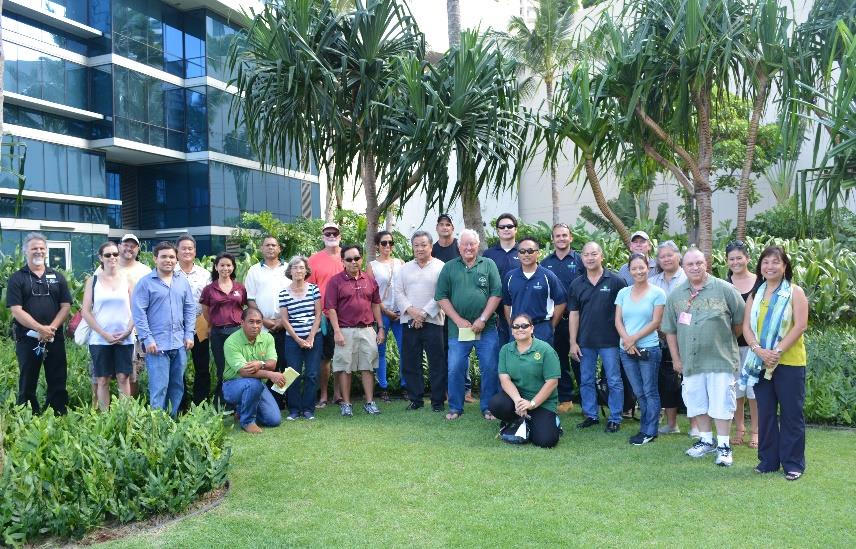
LICH 2015 Conference Tour Group at Waihonua
Kōʻula at Ward Village
This year’s tour theme of Soothing Landscapes starts off in Kakaako’s latest luxury condo, Kōʻula at Ward Village. Award winning architect, and Harvard School of Design Professor, Jeanne Gang designed the property with “Back to Nature” in mind. The blend of sculpture, art, and landscaping come together to create a tropical urban living neighborhood. The installation was masterfully done by Takano Nakamura Landscaping, who is the arguably Hawaii’s premier luxury condo landscaper. Architectural Digest called Ward Village, “the best planned community in the U.S.”
Come with us and see for yourself! More about Koula https://www.koulawardvillage.com/lifestyle/
ARCADIA
LICH's own Heidi Leianuenue Bornhorst will then lead us through the gardens of Arcadia. Conveniently located on three beautiful acres in Makiki, Arcadia has been offering a safe and vibrant retirement community for Honolulu’s seniors since 1967. Founded by Central Union Church with a commitment for compassionate and gracious care, they encourage all of their residents to live life to the fullest. Three acres of beautifully manicured property creates an Oasis in the middle of downtown Honolulu just minutes from the bustle of Waikiki. More about Arcadia https://arcadia.org/arcadia/
Manoa Heritage Center
After stopping for a delicious lunch, the tour will visit the Mānoa Heritage Center. Tours are limited and MHC made a special exemption to allow LICH members in that day. Founded in 1996 by Sam and Mary Cooke, Mānoa Heritage Center is a non-profit organization that reflects the Cooke family legacy of stewardship and preservation and is guided by a shared vision of inspiring people to be thoughtful stewards of their communities. Mānoa Heritage Center stewards Kūka‘ō‘ō Heiau, the only intact and restored heiau (ancient temple) in the greater ahupuaʻa (land division) of Waikīkī, Native Hawaiian gardens and Kūali‘i, the Cookeʻs 1911 Tudor-style home. Kūaliʻi is presently the Cooke family private residence and will open to the public in the future. Both Kūkaʻōʻō Heiau and Kūaliʻi are listed on the National Register of Historic Places. More about Manoa Heritage Center https://www.manoaheritagecenter.org/botanical-gardens/
As always, space is very limited for this tour and registrations are offered on a first come, first served basis. Registration will open this week. Only conference registrants are eligible to attend. Van shuttle pick-up and drop-off will be at the Ala Moana Hotel. Cost for this year’s tour is $60.
Brad Tanimura is a Landscape Architect for Bowers Kubota Consulting with 20 years of experience in Hawaii. He currently serves on the 2023 LICH Board of Directors.
Christy Martin to be Honored at Conference
by Chris Dacus
Christy Martin to be recognized with the green industry's highest honor bestowed by the Landscape Industry Council of Hawaii, LICH Director Emeritus.
The award ceremony will be held on September 14th at 8:30 am at the 2023 GREEN INDUSTRY CONFERENCE & TRADESHOW at the Hawaii Convention Center. The Landscape Industry Council of Hawaii or LICH Board of Directors are the leaders of the green industry. They are the master craftsmen representing the green industry professions: arborists, contractors, maintenance, plant nurseries, irrigation, research, education and
landscape architects.
To be recognized as a director emeritus requires exceptional leadership, teamwork and innovation sustained over five years rooted in caring for the environment, community and green industry. Previous recipients include Steve Nimz, Garrett Webb, Lelan Nishek, Jay Deputy, Boyd Ready and Chris Dacus, "Christy Martin joins an exclusive club only achieved by six individuals in 37 years. Christy will be the seventh LICH Director Emeritus.” said Jay Deputy, LICH President. Christy Martin has been an exceptional liaison between conservation and the green industry. She gracefully led the profession away from using invasive plants through the use of the Hawaii Pacific Weed Risk Assessment and later the website plantpono.org. Christy Martin is the Program Manager and PIO of Coordinating Group on Alien Pest Species (CGAPS).
Hawaii’s green industry is one of the fastest growing and largest segments of the green industry with an economic impact of over $520 million annually and full-time employment of over 11,000 landscape professionals.
Sponsored

Current exhibitors include:
